




a

At Healesville Primary School we have spent the past five years developing and implementing School Wide Positive Behaviour Support within our school. This form of Behaviour varies from many historical behaviour management plans in that School Wide Positive Behaviour Support (SWPBS) operates on the premise that as well as being learners of Literacy and Numeracy, children are also learners of behaviour.

Under this model, it is the role of the teachers (and school community members) to explicitly teach children appropriate behaviours and to set explicit behaviour expectations.

In the past, school-wide discipline has focused mainly on reacting to specific student misbehaviour by implementing punishment-based strategies including reprimands, loss of privileges, office referrals, suspensions, and expulsions.

Research has shown that the implementation of punishment, especially when it is used inconsistently and in the absence of other positive strategies is ineffective.

Introducing, modelling and reinforcing positive social behaviour is an important aspect of a student’s educational experience. Teaching behavioural expectations and rewarding students for following them is a much more positive approach than waiting for misbehaviour to occur before responding. The purpose of SWPBS is to establish a climate in which appropriate behaviour is the norm.

Our school community has identified and defined our four school Values:

Respect, Learning, Confidence, Community

We have created a matrix of expected behaviours that reflect these four values. To support the implementation of School Wide Positive Behaviour Support we collaboratively developed a Scope and Sequence, a collection of sample lesson plans and resources for teaching the different behaviour expectations around the four values. We have also developed a Behaviour Support Flow Chart that clearly outlines the procedures staff should follow when responding to minor and major behaviours. We use visuals in each classroom to remind and support the children about desired and expected behaviours.

We use data and feedback to plan our School Wide Positive Behaviour Teaching Program and the areas of the focus for different times of the year. Teachers use SWPBS explicit lessons in unison with the Respectful Relationships program which focus on the interpersonal and emotional skills that ensure student success.

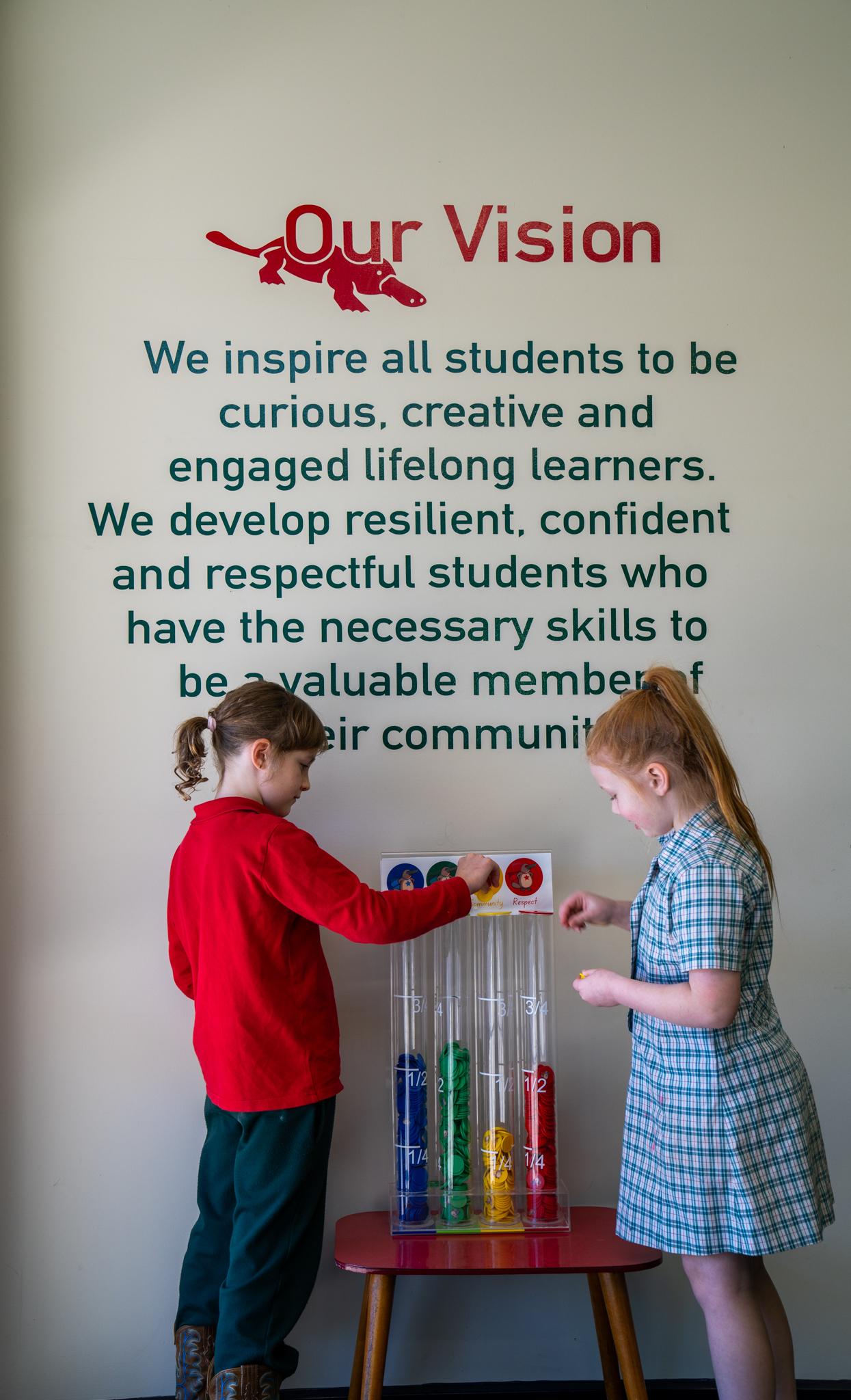
To recognise the positive choices made by students we use tokens as a reward system. Students have individual, class or whole school rewards, that are decided upon by the students, teachers and our Junior School Council. When students make inappropriate behaviour choices, the aim is to use re teach the desired behaviours and reward those following our rules and expectations.

For continued successful implementation of the SWPBS approach at Healesville Primary School, it is imperative that all staff are aware of how SWPBS works. This will ensure consistency of language, expectations and continued successful outcomes. Our teachers set up  SWPBS displays in each classroom to support students as well as calm down corners which help children to regulate their emotions, have a short break and then return to learning.

Regular lessons are taught to instil the SWPBS expectations and The Behaviour Matrix is visible and adhered to. Information about SWPBS is presented at assemblies, in the school Newsletter and at Parent Information Evenings. Our students are acknowledged for positive behaviours as individuals, as a class and as a whole school and the students and staff will participate in surveys, to collect data and evaluate the SWPBS program.

Since the introduction of SWPBS, our classrooms are calm, organised and a great place for learning to occur. SWPBS has contributed to individual well-being by fostering a sense of accomplishment, self-worth, and social connection. It also helps to lessen the cognitive load in our children’s learning as routines as so well embedded and frees space for more focus and learning to occur.